
Same Behavior. Different Judgment.
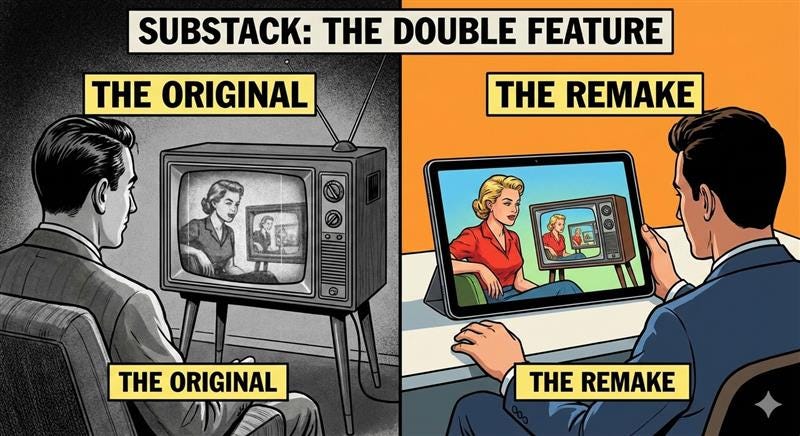
Hint: We’ve Seen This Movie Before. Warning: This post comes with some spoiler alerts.

A woman swears at work and it’s a “tone” issue.
A man swears and it’s authentic, or bold, or just keeping it real.
Julie Brown said this out loud this week, and it landed. Her post wasn’t actually about profanity. It was about who gets to break the “rules” and who gets penalized for doing the exact same thing.
And as I read it, I thought to myself, I literally just wrote about this same issue…although I didn’t.
Because in the last few months, I’ve been watching the same dynamic play out in a very different place.
AI adoption.
The Fire Up Focus version of this story
In our latest Fire Up Focus at work, I shared a Fast Company article about women being “slower” to adopt AI and asked women leaders across data, engineering, and technology how that claim matched their reality.
Spoiler alert: it didn’t.
What came back wasn’t reluctance. It was restraint. And this wasn’t just the feedback from the leaders I spoke with, this was echoed in all the comments we received and conversations I had after we shared it out.
Women talked about using AI thoughtfully, carefully, with judgment. They weighed ethics, credibility, voice, and downstream impact as part of the work, not as reasons to avoid it.
What they didn’t talk about was loudly advertising that experimentation.
Not because they weren’t curious or capable. Because visibility comes with a price tag, or what Fast Company referred to as the Competence Penalty.
Same double standard, new packaging
When men experiment loudly with AI, it’s innovation.
When women do the same thing, it can quietly trigger a different read: shortcuts, overreliance, questions about competence.
Same behavior but totally different interpretation.
So people do some quiet, back of the napkin math. They ask will this make me look less credible? Will using AI undermine my expertise? Who actually gets rewarded for “experimenting”?
In those environments, experimentation doesn’t stop. It just goes underground.
And then, somehow, that gets turned into a narrative of slower adoption.
The cultural signal we keep ignoring
On the surface, these may look like separate conversations:
Swearing is about professionalism.
AI adoption is about skills.
Confidence gaps are about individuals.
Second spoiler alert: They’re not.
They’re all the same cultural undercurrent wearing different hats.
When norms are enforced unevenly, people adapt. Not because they’re scared, but because they’re paying attention to the signals that are being given off. When the penalty for being visible is higher for some than others, discretion becomes a defense mechanism.
Julie didn’t argue that women should swear more (or less). She asked why we hear it differently when they do.
That’s the real question here too.
If this feels uncomfortably familiar…
Good, because this isn’t about encouraging women to be louder, messier, or more reckless.
It’s about building cultures where thoughtfulness isn’t mistaken for hesitation, where learning in public isn’t a professional risk, and where professionalism isn’t just code for “don’t make me uncomfortable.”
AI is becoming a career accelerator. Language has always been a credibility signal. In both cases, the work is the same.
Different domain. Same double standard. Same responsibility.
And if we’re honest, we’ve seen this movie before. The question is whether we’re finally ready to change the ending.